
The choice of a baby bed often starts with a question of dimensions, but size alone is not enough to ensure a suitable sleeping arrangement. Between the cradle for the first few weeks and the crib that will accompany the child for several years, each format meets a specific need related to age, morphology, and the space available in the room.
Mattress and structure: the duo that determines the safety of the baby bed
Even before comparing sizes, one technical point deserves the full attention of parents: the mattress must fit perfectly within the bed frame. A gap of more than two fingers between the edge of the mattress and the structure creates a risk of entrapment for the infant.
The European standards NF EN 716 (cribs) and NF EN 1130 (cradles) regulate the spacing of the bars and the strength of the structure. Checking for these references on the packaging or product sheet remains the most reliable reflex before purchasing.
To delve deeper into the comparison between formats, you can consult the advantages of baby beds on Maman du Net, which details the strengths and limitations of each dimension.
Another often overlooked element: the adjustable mattress height. On a crib, a high mattress position makes daily tasks easier when the baby is not yet rolling over. As soon as they start to sit up, lowering the mattress prevents any attempts at climbing.
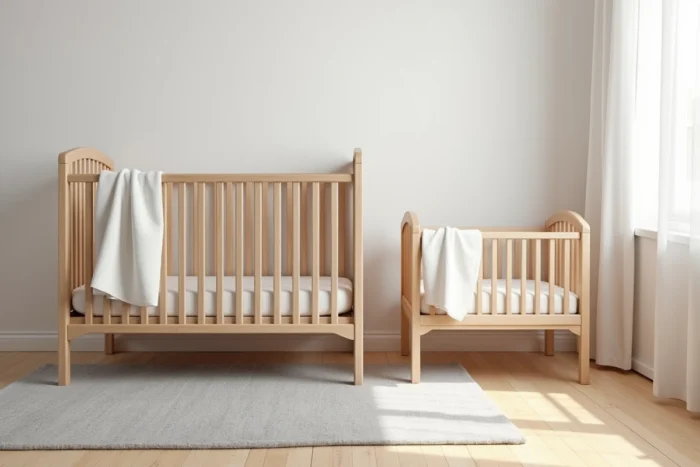
Cradle or 60 x 120 cm bed: at what age to switch
The cradle (approximately 40 x 90 cm) offers a contained space that reassures the newborn. Its small size allows it to be placed close to the parental bed or in a corner of the living room without rearranging the room.
Its duration of use remains short. When the baby starts to roll over or their size approaches the limits of the sleeping area, transitioning to a crib becomes necessary. For most children, this transition occurs between four and six months.
The 60 x 120 cm crib then takes over. It is the most common format in French bedrooms. Its advantages are concrete:
- It is suitable for small rooms, its footprint on the floor is moderate compared to a larger model.
- The choice of sheets, mattresses, and sleeping bags in this format is very wide, which simplifies purchases and limits the budget.
- It accommodates the child until they are two or three years old, depending on their growth.
The main limitation of the 60 x 120 cm is precisely this duration. A child who is tall for their age may feel cramped before turning two, which necessitates anticipating a new bed sooner than expected.
70 x 140 cm convertible bed: an investment that pays off
You may have noticed that some baby beds transform into small “big” beds? This is the principle of the 70 x 140 cm convertible bed. You remove the bars, adjust the mattress, and the child keeps the same piece of furniture until they are five or six years old.
On paper, the financial advantage is clear: one purchase instead of two. In practice, it requires nuance. The convertible bed costs more to buy than the standard 60 x 120 cm. The mattress in 70 x 140 cm is also slightly more expensive. The actual gain therefore depends on the initial price paid and the effective duration of use.
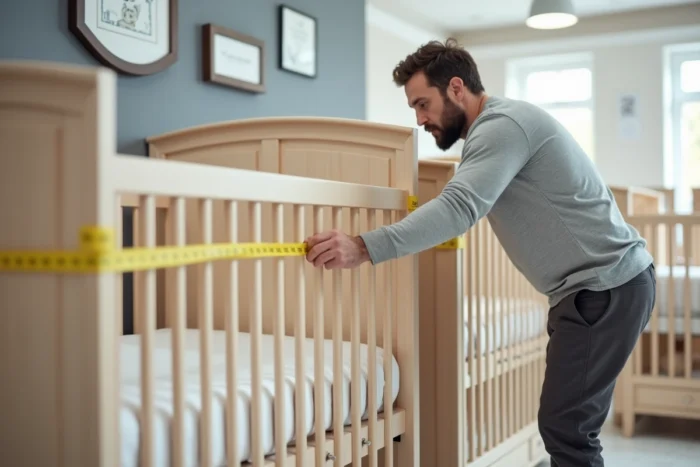
Space is another factor to consider before ordering. Twenty centimeters more in length and ten in width changes the flow in a small room. Place the bed on the floor with tape before purchasing: this simple trick allows you to check that the remaining space is sufficient for a changing area or a dresser.
When the 70 x 140 cm makes perfect sense
This format is particularly suitable for families who do not plan to move in the short term and who have a room of at least eight square meters. It also avoids the transition phase to a junior bed, often a source of nighttime awakenings when a child leaves a familiar environment.
Floor bed, cabin bed, travel cot: complementary formats to know
The Montessori-inspired floor bed appeals to parents who want to encourage the child’s independence as soon as they can walk. The mattress placed directly on the floor eliminates the risk of falling. However, it requires fully securing the room, as the child can leave their sleeping area freely.
The cabin bed, often a wooden structure surrounding the mattress, combines playfulness with a low sleeping area. Its volume can be surprising in a small room: measure the ceiling height if the room is sloped.
Why mention the travel cot in an article about size? Because many parents use it as the main bed at grandparents’ houses or on vacation. This folding format does not have the same firmness of mattress as a fixed bed. The travel cot remains a temporary sleeping solution, not a substitute for the daily bed.
Digital passport for children’s furniture: what to expect from 2029
The European regulation ESPR (EU 2024/1781) provides for a digital passport for many consumer products, including children’s furniture. A transition period of about four and a half years is planned. The first baby beds equipped with this passport are expected to appear on shelves between 2029 and 2030.
This passport will contain laboratory test reports and references to the harmonized standards applied. In practice, parents will be able to scan a QR code in-store to verify the bed’s compliance before purchasing. A notable advancement for comparing the safety of models without relying solely on the label.
The choice of the size of a baby bed is based on three overlapping criteria: the space of the room, the desired duration of use, and the overall budget (bed, mattress, linens). Measuring the room, checking the standards, and anticipating the child’s growth is enough to eliminate most bad options.