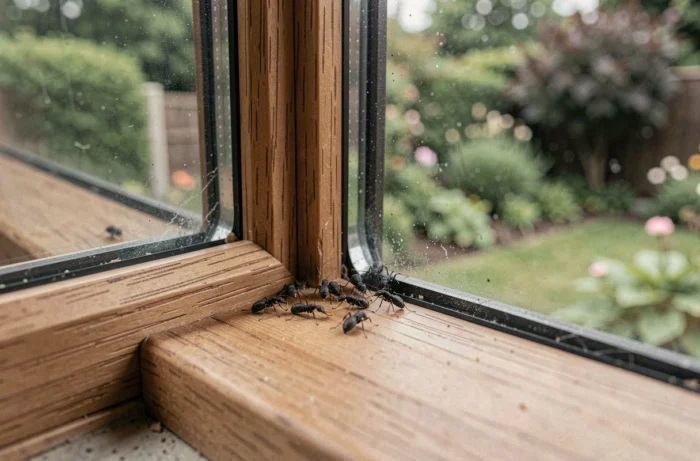
Identifying the small black insects that colonize the edges of windows requires distinguishing at least three common families: the carpet beetles (round beetles measuring 2 to 5 millimeters), the biting midges (tiny flies attracted to light), and the booklice (dust lice associated with humidity). Each responds to different attraction factors, which radically changes the elimination method.
Carpet beetles, biting midges, booklice: quick identification chart
Before any intervention, making a reliable diagnosis avoids blind treatment. The table below groups the observable characteristics to the naked eye for the three most frequent families near windows in France.
| Criterion | Carpet Beetle | Biting Midge | Booklice |
|---|---|---|---|
| Size | 2 to 5 mm | Less than 2 mm | 1 to 2 mm |
| Shape | Round, hard shell | Elongated, visible wings | Oval, soft body |
| Flight | Yes (adult) | Yes, attracted to light | Rarely |
| Main attraction factor | Textiles, organic dust | Artificial light in the evening | Humidity, mold |
| Egg-laying area | Baseboards, carpets, upholstered furniture | Outside (damp soil) | Paper, cardboard, window seals |
| Risk to habitat | Damage to textiles and collections | No material damage | No major damage |
If the insects are concentrated on the glass or curtain only in the evening, the presence of biting midges is the most likely. If you also spot hairy brown larvae in the baseboards or carpets, they are likely carpet beetles.
To better understand how to get rid of small black insects near windows, precise identification remains a prerequisite for any targeted action.

Window seals and entry points: the gap that most treatments ignore
Recent recommendations from specialized sites converge on one observation: blocking entry points is more effective than any insecticide. Aging PVC window seals, door bottoms without a threshold sweep, and ventilation grilles lacking fine mesh screens constitute the three main access routes.
A window seal that peels away by a few millimeters is enough to allow biting midges or booklice to enter. Adult carpet beetles, capable of flying, also enter through openings left ajar without a screen.
Concrete verification in four points
- Run a finger along the peripheral seal of each opening to detect areas that are peeled away or hardened over time
- Check that the ventilation grilles (VMC, air intakes) are equipped with a mesh screen with openings smaller than 1 mm, the only size that blocks the smallest flies
- Inspect the threshold of the front door and patio doors (a gap of a few millimeters under the door leaf is a highway for crawling insects)
- Examine the roller shutter boxes, often forgotten: poorly repositioned access panels create a direct entry from the outside
Replacing a foam window seal is inexpensive and can be done without specific tools. However, resealing a roller shutter box may sometimes require removing the interior panel and reapplying a silicone seal.
Non-biocide elimination methods: vacuuming, steam, washing
As of January 1, 2026, any professional applying biocidal products in a dwelling must hold a personalized Certibiocide valid for five years. This requirement encourages the use of mechanical and thermal methods for common domestic infestations.
Targeted vacuuming
The vacuum cleaner remains the frontline tool. Using the narrow nozzle on window sills, baseboards, floor grooves, and closet corners eliminates both adults and larvae. Empty the bag or bin immediately afterward, outside, to prevent any reinfestation from the vacuum cleaner itself.
Steam and high-temperature washing
For carpet beetles whose larvae attack textiles, washing in a machine at 60 °C destroys all larval stages. Non-washable fabrics (heavy curtains, cushions, carpets) can be treated with a steam cleaner, whose output temperature far exceeds the lethal threshold for these beetles.
Freezing is an alternative for fragile items (entomological collections, antique textiles). Placing the item in an airtight bag in the freezer for several days eliminates larvae and eggs without chemical damage.
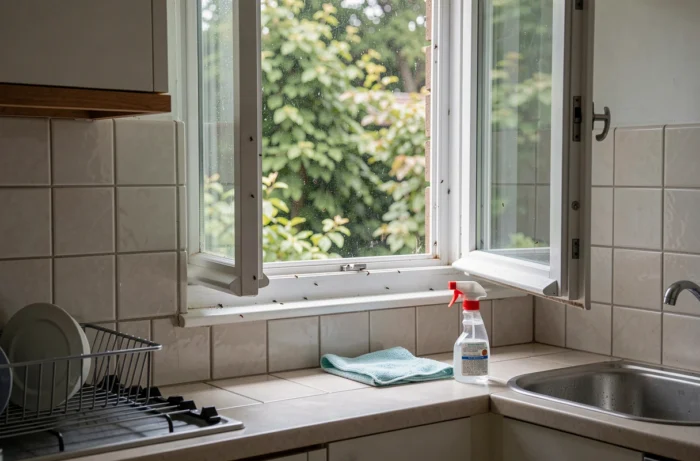
Indoor humidity and small black insects: the underestimated link
Booklice do not feed on textiles. Their diet relies on micro-molds that develop on damp surfaces: bathroom seals, papers stored in poorly ventilated rooms, and single-glazed window edges where condensation accumulates.
Reducing relative humidity below 60% makes booklice disappear within weeks, without any chemical treatment. In practice, this involves proper ventilation (functional VMC, daily airing for ten minutes) and addressing thermal bridges around windows.
If condensation returns despite ventilation, the problem is structural: poor insulation of the frame, single glazing, or a clogged VMC. In this case, the insect is merely a symptom. Addressing humidity simultaneously resolves the entomological issue and prevents more costly damages (wall mold, peeling paint).
When to call a certified professional
For biting midges and booklice, professional intervention is rarely justified. Sealing openings and controlling humidity are sufficient in the vast majority of cases.
The situation changes with carpet beetles when the infestation affects multiple rooms, larvae are found in ventilation ducts, or damaged textiles number in the dozens. A professional holding the Certibiocide can then apply a localized treatment (gel or targeted spray) in addition to mechanical methods.
Using a consumer fogger, often presented as a miracle solution, disperses an insecticide throughout the entire living space without targeting egg-laying areas. Its actual effectiveness on larvae hidden in baseboards or textiles remains very limited. Methodical vacuuming followed by sealing access points produces more lasting results, without unnecessary chemical exposure.