
The home cooling market at Electro Dépôt often boils down to two options: a budget-friendly fan or a Valberg portable air conditioner. Both carry the same private label brand, occupy the same shelves, but serve entirely different needs. Behind the price gap lie differences in electricity consumption, cooling capacity, and installation constraints that product specifications do not always detail.
Valberg Portable Air Conditioner and RE2020 Regulations: An Often Ignored Angle
For owners of new homes, the question of cooling methods has a regulatory dimension. A Valberg portable air conditioner, simply plugged into an outlet, does not count towards the RE2020 thermal calculation of the building. Only fixed equipment (splits, reversible heat pumps) are taken into account in the Cep study and the PCMI14 certificate.
In practical terms, choosing a mobile unit rather than a fixed split allows for cooling a new home without altering its regulatory compliance. For buyers who have received their RE2020 certificate, this is a strategic point: installing a fixed air conditioner afterward can call into question the declared performance of the building.
This issue also concerns tenants. A portable air conditioner does not require any declaration to the town hall, nor does it need the intervention of a certified technician, unlike split systems that handle refrigerants. The F-Gas regulatory framework, which is tightening in Europe with the gradual reduction of R-32 and R-410a gases, does not directly affect mobile monobloc units. To delve deeper into this topic, a review of the Valberg portable air conditioner at Electro Dépôt details the practical implications of this choice.

Electricity Consumption: Fan vs. Valberg Portable Air Conditioner
This is the point that should be at the forefront of any consideration, yet it is systematically missing from promotional content. According to 60 Millions de consommateurs, a fan consumes about twenty times less electricity than a portable air conditioner for comparable use during the summer period.
Over a full summer of regular use, a fan’s bill amounts to just a few euros. In contrast, the bill for a portable air conditioner rises significantly higher, a discrepancy that the initial purchase price does not reflect. A Valberg unit sold at an attractive price at Electro Dépôt can incur operating costs that exceed its purchase price within two or three seasons.
What the Air Conditioner’s Fan Mode Does Not Compensate For
Most Valberg portable air conditioners offer an integrated fan mode. On paper, this gives the impression of two devices in one. In practice, the airflow of a portable air conditioner in fan mode remains lower than that of a dedicated fan of equivalent range. The motor is not optimized for this sole use.
The night mode reduces noise but also airflow, which limits the perceived effectiveness. A Valberg column fan, designed to circulate air with a controlled noise level, performs this specific function better.
Technical Comparison: What Really Separates the Two Devices
Beyond price and consumption, several technical criteria deserve precise analysis:
- The actual cooling capacity of a portable air conditioner depends on the room’s airtightness. The exhaust duct, placed on a partially open window, creates a thermal bridge that reduces efficiency. Without a sealing kit, a significant portion of the cold produced is lost through the incoming warm air.
- The fan does not cool the ambient air. It accelerates the evaporation of sweat, which creates a feeling of coolness. In a room above 35 °C, this sensation becomes insufficient for real comfort.
- The Valberg portable air conditioner often includes a dehumidifier function, useful in humid homes. A fan has no effect on humidity levels, which can make the heat even harder to bear.
- The weight and bulk of the portable air conditioner (often over twenty kilos) limit its actual mobility. A fan can be moved from one room to another in seconds.
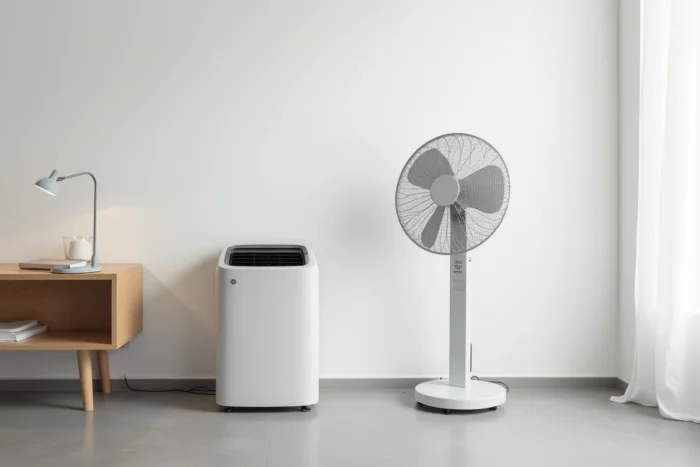
Portable Air Conditioner or Fan from Electro Dépôt: When to Choose One Over the Other
The choice depends on the layout of the home and the heat threshold you consider tolerable. A fan is sufficient in the majority of summer situations in metropolitan France, especially in regions where episodes above 33 °C are occasional.
The Valberg portable air conditioner makes sense in three specific cases: an attic apartment facing south, a room without cross ventilation, or a need for dehumidification in coastal areas or damp ground floors. Outside of these configurations, the cost-to-comfort ratio favors the fan.
The Pitfall of Oversizing in Open Rooms
In a home with an open kitchen to the living room, the actual area to be treated often exceeds the announced capacity of the portable unit. An undersized portable air conditioner runs continuously without reaching the target temperature, which drives up electricity consumption without noticeable comfort gain.
Field feedback varies on this point: some users report satisfactory performance in small closed rooms, while others find it nearly ineffective in open spaces. The technical specifications alone are not enough to predict the actual outcome in your home.
The Valberg brand, owned by the Electro Dépôt group, positions itself in the entry-level segment of household appliances. The devices are functional and offered at competitive prices, but the materials and durability lag behind brands specialized in air conditioning. For occasional use of a few weeks per year, this compromise may be acceptable. For daily use over several months, the question of longevity arises.