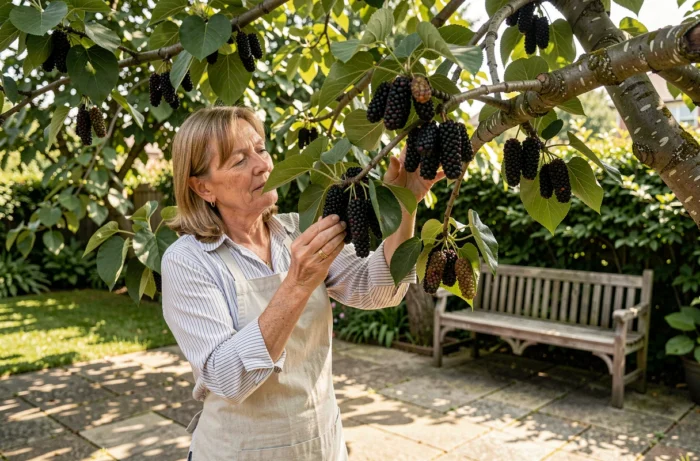
The plane tree mulberry refers less to a specific botanical species than to a form of cultivation: a white mulberry (Morus alba) pruned into a flat shape, typical of Mediterranean gardens. Two trees sold under this name can produce very different fruits, both in quantity and flavor. The commercial name guarantees nothing about the fruit quality. To harvest truly enjoyable mulberries, the choice hinges on the exact botanical name, the type of cultivar, and some checks at the nursery.
Morus alba, Morus nigra, sterile cultivar: what the label hides
The term “plane tree mulberry” actually encompasses several very different situations. A standard seedling of Morus alba will yield white or pink fruits, often bland. A selected cultivar of the same Morus alba can produce black, sweet, and fragrant mulberries. A specimen labeled Morus kagayamae ‘Fruitless’ will never bear fruit.
The classic trap: buying a tree based solely on the mention “plane tree mulberry” without checking the full Latin name. Some nurseries sell specimens from unselected seedlings, whose fruiting remains uncertain. Others offer identified fruiting cultivars, with known taste characteristics.
To navigate this, three categories deserve to be distinguished on the label:
- Morus alba (typical form): white to pink fruits, sweet but not very aromatic, sometimes tasteless depending on the clone
- Morus nigra (black mulberry): smaller fruits, dark red to black, significantly more flavorful, with a balanced acidity reminiscent of wild blackberries
- Morus kagayamae ‘Fruitless’: sterile variety selected for shade, no fruit production
When the goal is to eat the mulberries, Morus nigra offers the most flavorful fruits. Morus alba remains interesting provided you choose a selected fruiting cultivar, not a generic seedling. A detailed guide on the edible fruits of the plane tree mulberry helps clarify these distinctions before purchase.
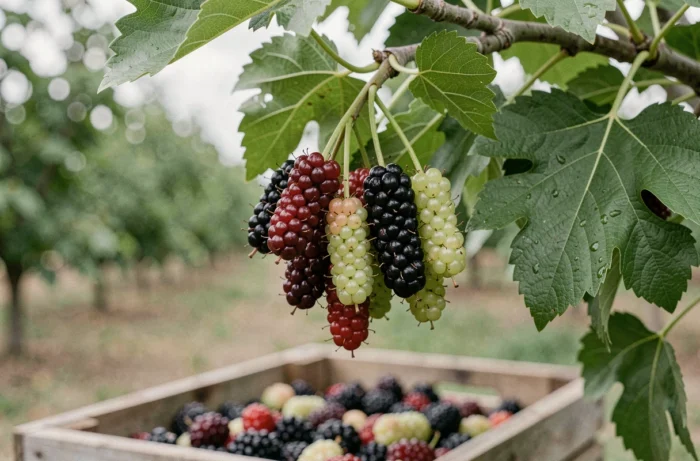
Dwarf fruiting cultivars: Mojo Berry and Matsunaga for small gardens
Online competitors almost exclusively discuss large specimens shaped like umbrellas. Dwarf fruiting cultivars are rarely mentioned, even though they meet a real need: to produce edible mulberries without requiring a large space or waiting years.
The ‘Mojo Berry’ cultivar is a compact mulberry that fruits within the first few years after planting. Its small size makes it suitable for pot cultivation on a terrace. The fruits are black, sweet, and harvested in summer.
‘Matsunaga’ follows the same logic: a very contained growth habit, quick fruiting, and good quality mulberries. These two cultivars are available from specialized nurseries, particularly in the UK (RHS) and Switzerland.
The appeal of these dwarf varieties goes beyond mere space-saving. A compact specimen fruits faster than a large mulberry shaped into a flat form, which spends its early years developing its framework. For a gardener eager to taste their own mulberries, this is a significant advantage.
Fruiting of the plane tree mulberry: pitfalls to avoid before purchase
Buying a “fruiting” plane tree mulberry without caution exposes you to two common disappointments. The first: a tree that produces abundant mulberries but with no taste interest, because it is an unselected Morus alba. The second: a tree that produces nothing at all, because the sterile cultivar was sold without clear mention.
Check the fruiting behavior at the nursery
The most reliable method remains to visit the nursery during the fruiting period (late spring to early summer depending on the region). Observing a mother plant in fruit allows you to judge the color, size, and abundance of the mulberries. If a visit is not possible, explicitly ask whether the specimen is from cuttings or grafting of an identified fruiting plant, and not from a seedling.
A mulberry from a seedling may never reproduce the fruiting qualities of the mother plant. Cuttings or grafting guarantee stable genetic identity.
Anticipate stains and planting distance
Black mulberries stain tiles, furniture, and clothing permanently. A landscaper recommends planting the mulberry at least three meters from a wall or terrace, not one meter as is sometimes seen. This distance limits mess while retaining the benefit of shade.
This detail may seem minor, but it is the main reason some owners end up regretting their choice of fruiting variety and would have preferred a sterile cultivar. It’s better to think about this before planting than after.
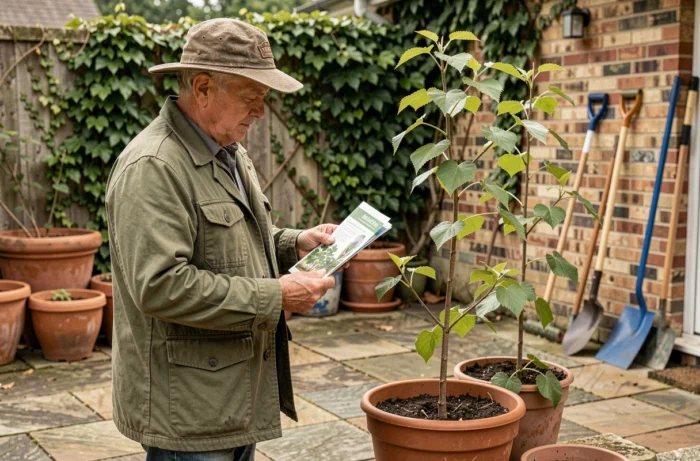
Soil, exposure, and pruning: conditions for good mulberry production
The plane tree mulberry tolerates various soils, but a deep and well-drained soil promotes regular fruiting. In overly compact or waterlogged ground, the tree survives but produces less, with smaller fruits.
Full southern exposure remains the most favorable in the northern half of France. In a Mediterranean climate, slightly sheltered exposure from the prevailing wind is sufficient. The mulberry withstands summer heat well, which explains its historical presence in the south.
Pruning occurs in the fall or late winter, outside of frost periods. On a fruiting specimen, pruning aims to maintain the umbrella shape while retaining enough branches from the previous year, as mulberries form on one-year-old wood. Pruning too severely each year reduces the following harvest. A balance must be struck between the desired shape and the fruiting potential.
Planting ideally takes place in spring in cooler regions, or in autumn in mild climates. Regular watering in the first year aids rooting, after which the mulberry is water-efficient once established.
The choice of a fruiting plane tree mulberry boils down to a check that many overlook: reading the full botanical name on the label, then confirming the propagation method with the nurseryman. Without these two pieces of information, the term “plane tree mulberry” says nothing about what the tree will actually produce on the plate.