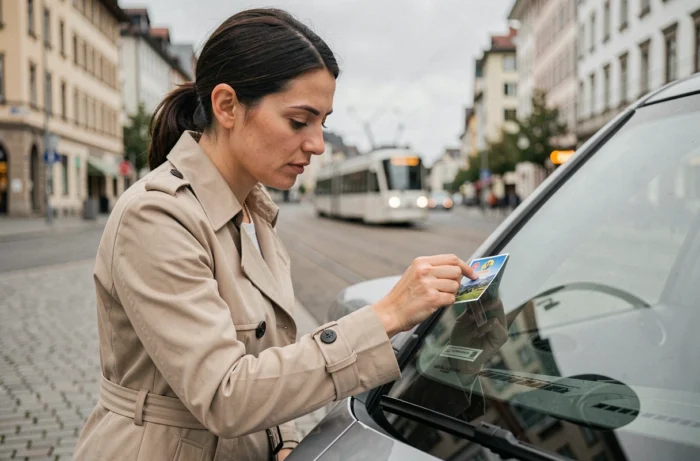
Switzerland does not apply the French Crit’Air system. The two sticker systems – the Swiss motorway vignette and Crit’Air – operate under distinct logics, and confusing them can be costly for drivers crossing the border. Understanding their respective scopes helps avoid fines on Swiss highways and restrictions in French low-emission zones (ZFE).
Motorway vignette and Crit’Air: two systems separated by the border
The Swiss vignette is an annual fee that grants access to highways and certain national roads. It applies to all motorized vehicles up to 3.5 tons, regardless of engine type or pollution level. An Euro 3 diesel and an electric car pay the same amount and receive the same right to drive.
The Crit’Air sticker classifies vehicles by pollution category. It does not fund roads but regulates access to low-emission zones established by French local authorities. The two systems do not replace each other.
A French driver entering Switzerland needs the motorway vignette, not the Crit’Air. Conversely, a Swiss resident driving in a French ZFE (Lyon, Grenoble, Strasbourg) must display a Crit’Air sticker on their windshield, even if they already have their Swiss vignette.
To delve deeper into the procedures related to the Swiss Crit’Air vignette on Racing Fans, several resources detail the formalities according to the type of vehicle and the country of registration.
Swiss e-vignette: the digital transition in midstream
Since 2023, the Confederation has offered an electronic version of the motorway vignette, linked to the vehicle’s license plate. The principle: no need to stick anything, the plate number is recorded in a database accessed by control cameras.
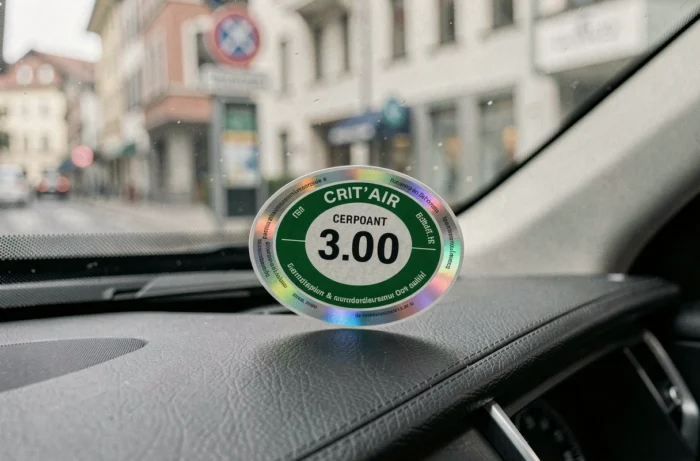
However, the growth of digital sales remains gradual. About 35% of the vignettes sold were electronic in 2024, a proportion that rose to 45% in 2025. The Confederation anticipates just over 50% in 2026. The Federal Council specified that the adhesive vignette will only disappear when e-vignettes exceed 90% of sales, a threshold that will not be reached for several years.
For foreign drivers, the e-vignette offers a practical advantage: it can be purchased online before departure, without going through a physical point of sale at the border. However, it requires entering the exact plate number. A typing error renders the vignette invalid, and automated checks leave no margin for error.
The trap of third-party resellers
The digital format has led to the emergence of private platforms that resell the e-vignette with sometimes high service fees. Some sites charge an additional fee that can represent a significant portion of the official price.
The only guaranteed channel at the regulated price remains the Confederation’s portal (via the Federal Office of Customs and Border Security). Other intermediaries are not illegal, but the added processing fees are not always clearly disclosed before payment.
Geneva’s ZFE and the Stick’Air eco-sticker: the Swiss particularity
Switzerland does not have a ZFE network comparable to that of France. Geneva is an exception with its temporary environmental zone, activated only during pollution peaks (smog alerts). The system relies on the Stick’Air eco-sticker, which classifies vehicles according to their emission levels, based on a model similar to the French Crit’Air.
The two stickers are indeed interchangeable under certain conditions: a vehicle registered in France that already displays a Crit’Air can circulate in Geneva without purchasing an additional Stick’Air, provided that the category corresponds to the activation level of the alert. This equivalence only works in this direction and only in Geneva.
- The Stick’Air is only required during smog alerts, not permanently. Outside of these episodes, no emission-related traffic restrictions apply in Geneva.
- The activation levels are progressive: the first tier restricts only the most polluting vehicles (categories 4 and 5), while higher tiers expand the prohibition.
- Passing vehicles are not exempt. A tourist crossing Geneva during a smog alert without a compliant sticker is subject to a fine.
Administrative procedures based on the country of registration
The formalities differ depending on whether the vehicle has a Swiss or foreign plate. For a vehicle registered in France, the motorway vignette must be purchased before or at the time of crossing into Switzerland. Physical points of sale (customs, gas stations, Swiss post offices) continue to issue the adhesive version. The e-vignette can be ordered online by entering the plate number and the country of registration.
For the Crit’Air, a Swiss resident traveling to France must order their sticker on the official website of the French Ministry of Ecological Transition. The request requires the vehicle’s registration certificate and the Euro standard listed on it. The delivery time by mail can take several weeks for shipments outside France.

Common mistakes at the border
- Confusing the motorway vignette with the pollution sticker: the former is mandatory on highways regardless of the engine type, while the latter is only required in French ZFEs (and in Geneva during alerts).
- Buying the e-vignette on a third-party site without checking service fees, then discovering a charged amount higher than the official price.
- Forgetting that the Swiss vignette covers a calendar year, not twelve rolling months: it is valid from December 1 of the previous year to January 31 of the following year.
- Not checking the correspondence between the Crit’Air category and the actual Euro standard of the vehicle, especially for older diesels that may shift from one category to another depending on the date of first registration.
The coexistence of these systems reflects different philosophies: infrastructure funding on the Swiss side, environmental regulation on the French side. For a driver who regularly crosses the border, the only reliable approach remains to treat each obligation separately, without assuming that one sticker replaces another.