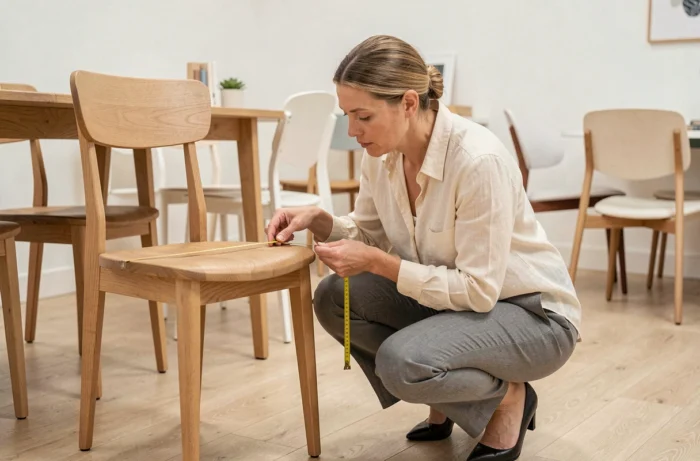
A chair that is too low forces you to lift your shoulders to reach the table. A chair that is too deep compresses the back of your knees after a few minutes. These discomforts do not stem from a manufacturing defect, but from a poorly chosen dimension in relation to the user’s needs and morphology. Understanding the few key measurements can help avoid a disappointing purchase.
Seat height and table height: the duo to check first
Have you ever noticed that a chair that is perfectly comfortable at a friend’s house becomes uncomfortable at yours? The difference often lies in the table, not the chair itself. The gap between the table top and the seat determines your posture.
For a standard dining table (about 75 cm high), a seat height between 45 and 48 cm works well. This gap of 25 to 30 cm between the seat and the table top leaves enough room for the thighs without forcing the shoulders to rise.
If you have a bar table, which is higher, the logic remains the same: maintain this gap of 25 to 30 cm, which leads to bar stools or high chairs. This is also a useful reference for anyone wanting to learn everything about standard chair dimensions before placing an order.
A common pitfall: measuring the chair alone, without considering the table it will be paired with. A chair with a seat height of 48 cm is suitable for a table of 75 cm, but becomes uncomfortable under a table top of 72 cm.
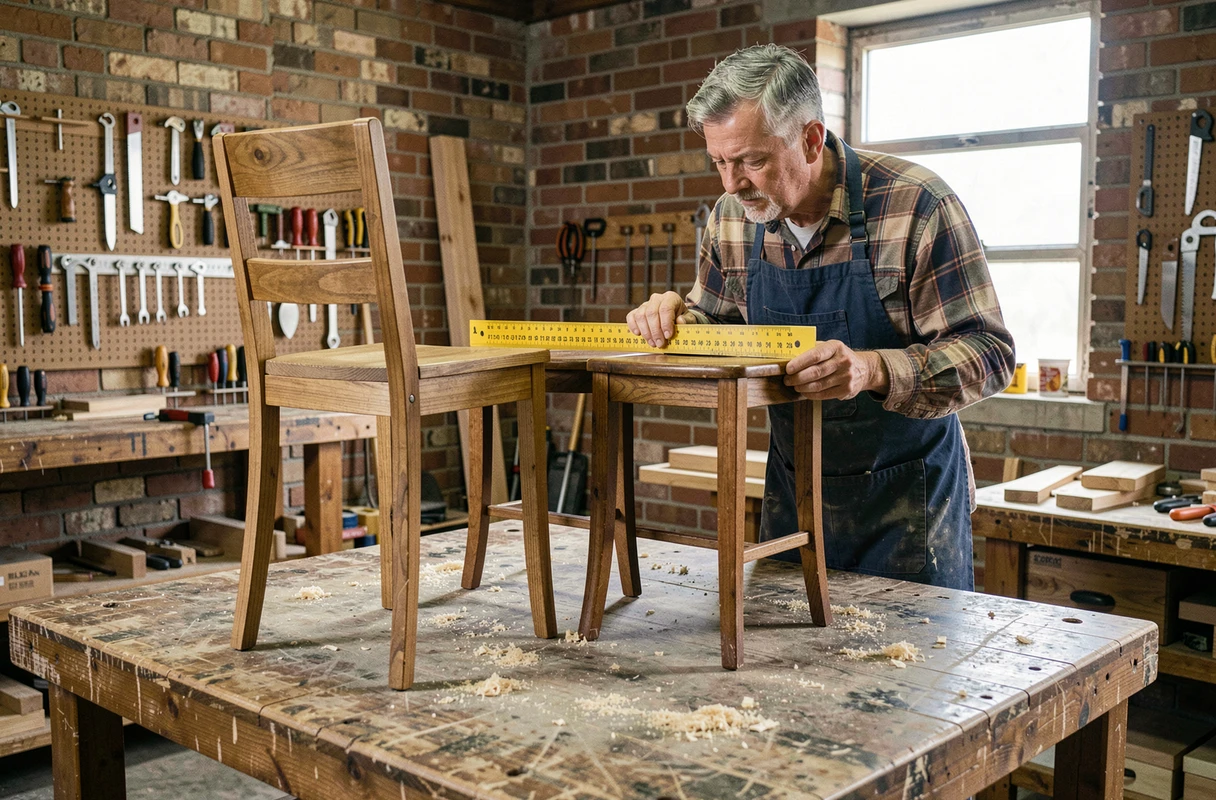
Seat depth: the criterion most buyers forget
Depth is the distance between the front edge of the seat and the backrest. It directly influences posture and long-term comfort.
A depth of 40 to 45 cm is suitable for most adults for table use. This range allows you to lean your back against the backrest while keeping a few centimeters between the edge of the seat and the back of your knees.
Why does this detail matter so much? When the seat is too deep, two reflexes occur. Either you slide forward and your back is no longer supported. Or you stay pushed back and the edge of the seat presses against your calves, which hinders blood circulation.
- For a standard meal (less than an hour), 40 cm of depth is sufficient and promotes an upright posture.
- For extended dinners or office use, 45 cm provides a bit more contact surface with the thighs, reducing pressure.
- Beyond 50 cm, you enter the realm of lounge chairs, designed for a more relaxed posture, unsuitable for a table.
Seat width and space between guests around a table
The seat width of a chair typically ranges from 40 to 50 cm. This number alone is not enough: it’s the total footprint of the chair, including armrests, that determines the number of places around the table.
Count about 60 cm of width per person so that everyone can sit down without bumping elbows. On a table that is 180 cm long, this allows for three places on each side, or six guests in total.
Armrests: check the clearance under the table
Armrests add comfort, especially for long meals. In return, they increase the overall width of the chair. Measure the height of the armrests in relation to the underside of the table top: if the armrests do not fit underneath, the chair cannot be stored and will encroach on the circulation space.
This point is often overlooked when purchasing online, where the photo does not provide any reliable scale.

Circulation space behind the chair: a simple calculation that changes everything
A well-sized chair but stuck against a wall or furniture remains uncomfortable on a daily basis. Allow 70 to 80 cm behind an occupied chair so that a person can pass without asking everyone to stand up.
In practical terms, add the depth of the chair (including the back legs) and the necessary space to step back when someone is seated. In a narrow room, chairs without armrests and with shallow depth free up valuable centimeters.
EN 1335 standard for office chairs: dimension alone is no longer enough
For office use, the requirements go beyond simple centimeters. The European standard EN 1335, strengthened in 2026, now imposes criteria for dynamically adjustable lumbar support and load distribution along the spine. It also regulates the height adjustment range, seat depth, and armrest characteristics.
The goal of this standard is to prevent musculoskeletal disorders (MSDs), the leading cause of occupational illness related to the workplace. A compliant office chair covers a sufficient range of adjustments to accommodate various body types, which a fixed dining chair does not.
- Check that the seat height is adjustable over a sufficient range for your height.
- The backrest should provide adjustable lumbar support, not just a decorative cushion.
- Height-adjustable armrests allow you to rest your forearms without raising your shoulders.
Before investing in an office chair, the mention of compliance with the NF EN 1335-1 standard on the product sheet remains the most reliable reference.
Choosing a chair involves cross-referencing three measurements with a specific use: seat height in relation to the table, depth suitable for the duration of use, and total footprint in the available space. A tape measure and five minutes are enough to avoid a return or months of discomfort.