
The volume of weddings celebrated in France in 2024 is around 247,000 to 248,000 unions, according to the demographic report from Insee published in January 2025. This marks a recovery compared to 2023, but remains structurally lower than the levels seen in the early 2000s. This demographic context directly impacts the choices of service providers and the structuring of the wedding offer.
Separation of the legal and festive aspects: what the hybrid wedding changes
The most significant trend in 2024 is not aesthetic; it is organizational. We are observing an increasing dissociation between the civil ceremony at the town hall and the festive reception, sometimes spaced several weeks apart. This format, often referred to as a hybrid wedding, profoundly alters the specifications for wedding planners and reception venues.
This separation is partly explained by the competition from PACS, which now covers a large share of legal unions in France. Notaires de France reminds us that marriage, PACS, and cohabitation offer distinct legal frameworks, and the choice of marriage is increasingly a symbolic decision rather than an administrative necessity.
For service providers, the consequence is concrete: the budget is focused on the festive day. Couples are investing more in scenography, catering, and guest experience, sometimes at the expense of floral arrangements or stationery. This budget rebalancing pushes caterers and decorators to offer modular packages, adapted to shorter but more intense reception formats.
To follow these developments month by month, find all the news on Esprit Mariage covering both regulatory changes and new service providers.

Wedding budget 2024: rising costs and real choices by couples
The catering budget remains the largest expense, and the rise in food costs since 2022 has not been mitigated. Couples are making different choices depending on whether they opt for a classic seated meal or an extended cocktail format. The latter format is significantly gaining ground as it allows for a reduction in cost per guest while extending the reception time.
Another pressured budget item is the venue rental. Demand is concentrated on estates and castles with integrated accommodation, which eliminates the transportation cost for guests. Venues that offer an all-in-one package (accommodation, catering, coordination) are capturing an increasing share of the market.
Cost savings are being made elsewhere. Physical stationery is declining in favor of digital invitations. Traditional photo albums are giving way to online galleries shared with guests. And in terms of entertainment, participatory formats are gradually replacing heavier services.
Three common budgetary choices in 2024
- Reducing the number of guests to enhance the quality of the experience per person, with smaller receptions but a higher unit budget
- Eliminating the ceremonial vehicle in favor of investing in lighting for the venue, which creates a stronger visual impact in photos
- Replacing the traditional tiered cake with a signature dessert or a pastry bar, which is less expensive and more suited to the cocktail format
Secular ceremony and personalization: beyond the trend, a standard
The secular ceremony is no longer a trend; it is a market standard. The majority of receptions now include a personalized ceremonial aspect, distinct from the civil ceremony at the town hall. What changes in 2024 is the level of expectation from couples regarding the content of this ceremony.
Professional officiants report an increased demand for scripted ceremonies, with calibrated interventions from loved ones, symbolic rituals chosen by the couple, and a controlled duration. The average targeted time is between twenty and thirty minutes, compared to longer formats a few years ago.
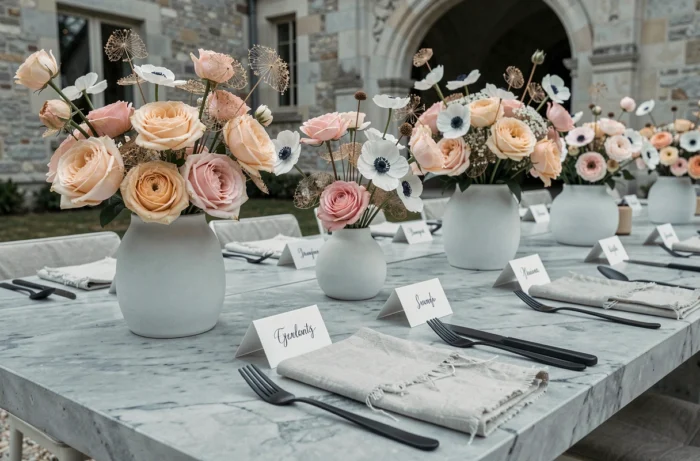
We recommend that couples work on the ceremony text at least three months before the big day. The quality of the writing and the coherence of the flow make the difference between a memorable ceremony and a series of disjointed speeches. Officiants who offer comprehensive writing support justify a higher fee, and guest feedback consistently confirms this.
Weddings with foreign spouses: regulatory vigilance in 2024
A topic rarely addressed in trend articles, but which affects thousands of couples each year: weddings involving a spouse of foreign nationality are under increased scrutiny regarding presumed fraud. Mayors, who are on the front lines for the celebration, must navigate sometimes vague reporting obligations and extended administrative timelines.
For the couples involved, this translates into heavier advance procedures: compiling the marriage file, separate hearings at the town hall, extended publication delays for the banns. The Senate has also examined a proposed law aimed at clarifying the intervention framework for local elected officials in the face of suspicions of fraudulent marriages.
Points of vigilance for binational couples
- Prepare the marriage file at least four months before the desired date, including translation and legalization delays for foreign documents
- Plan for a hearing at the town hall and inquire about local practices, which can vary significantly from one municipality to another
- Consult a notary regarding the property implications of the chosen matrimonial regime, especially in cases of assets located in two different countries
Marriage in 2024 is characterized less by spectacular aesthetic breaks than by deep organizational and regulatory changes. The dissociation between the legal and festive aspects, the budgetary rationalization by item, the rise in quality of secular ceremonies, and the complexity of binational files shape a more mature market, where providers who invest in advice and support gain an advantage over those who only sell services.