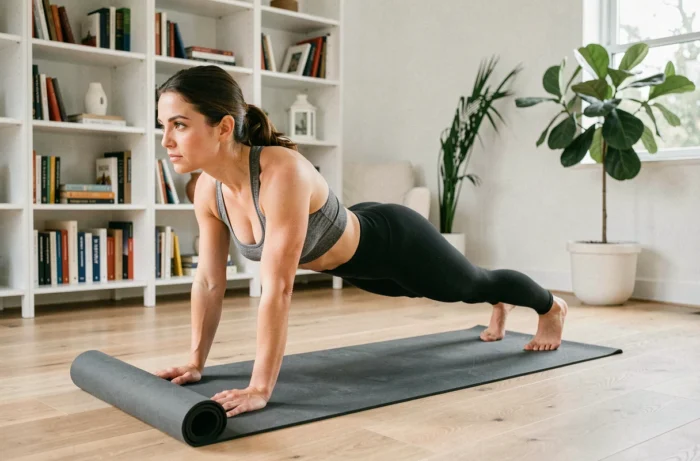
Home fitness is based on a simple principle: applying sufficient mechanical stress on the muscles to provoke adaptation, without depending on a location or a subscription. The challenge lies not in choosing exercises, but in managing progression, training volume, and recovery over several weeks.
Movement Patterns: The Foundation of a Home Fitness Program
Rather than thinking in terms of isolated muscles (biceps, shoulders, chest), bodyweight training benefits from being structured around fundamental movement patterns. This approach, increasingly popular in training apps, allows for full-body coverage with a reduced number of exercises.
Six patterns are enough to build a complete session: horizontal push (push-ups), vertical push (pike push-ups), pull (inverted rows under a table), squat, hip hinge (hip thrust, single-leg deadlift), and core stabilization. Each session combines at least three of these patterns to engage both the upper and lower body.
The concrete advantage: by varying positions and tempos on these movements, you can build months of progression without adding equipment. Before looking to read fitness tips on Athlon News, identify the patterns you already master and those that require prior technical work.
Sets, Repetitions, and Tempo: Managing Progression Without Weights
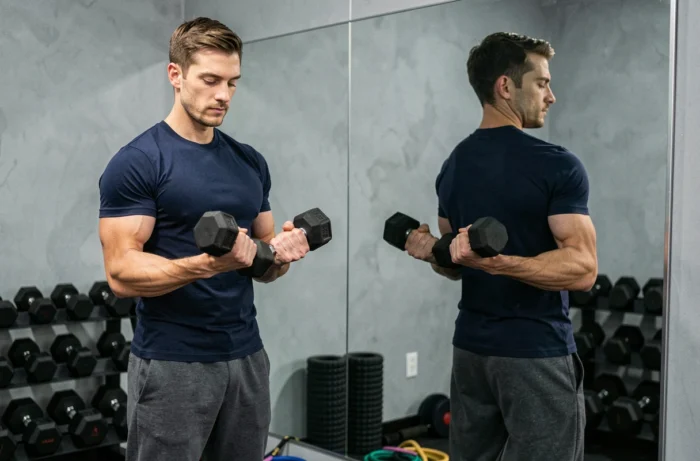
In a gym, progression comes from adding weight to the bar. At home, without external load, the main lever remains volume and tempo. Three variables allow for continued progression week after week.
Increase Volume in Steps
An effective strength training program starts with a moderate volume, for example, three sets of eight to twelve repetitions per exercise. The increase in load occurs by adding a set or a few repetitions each week, without exceeding a threshold where technique deteriorates.
Spacing sessions targeting the same muscles by at least forty-eight hours protects tissues and allows for complete recovery. In a typical week, three to four sessions are sufficient to maintain regular stimulation while allowing for rest days.
Play with Execution Tempo
Slowing down the eccentric phase (the descent of a push-up, for example) increases time under tension without changing the exercise. A tempo of three seconds on the way down, a one-second pause at the bottom, followed by a controlled ascent transforms an easy movement into a demanding exercise for muscle mass.
- Slow tempo (4 seconds on the eccentric): promotes hypertrophy and corrects strength imbalances between the right and left sides
- Explosive tempo (fast ascent, controlled descent): develops power and recruits more muscle fibers
- Isometric pauses (holding the low position for two to three seconds): strengthens the weakest joint angles and improves shoulder and knee stability
Progression without equipment relies on these micro-adjustments, not on accumulating different exercises in each session.
Creating a Functional Training Space at Home
The layout of the training area is a technical subject often underestimated. A poorly designed space limits movements, increases the risk of injury, and ultimately discourages.
The floor conditions the quality of the training. A shock-absorbing surface (high-density foam tiles or thick mats) absorbs impacts during dynamic exercises and protects joints during floor work. On tile or bare wood, knees and wrists endure unnecessary stress.
Ventilation plays a direct role in performance. A closed room without air circulation leads to rapid overheating, reduces endurance, and increases the perception of effort. Opening a window or installing a fan directed towards the work area significantly improves comfort during sessions longer than twenty minutes.
The minimum useful space corresponds to the area needed to lie down with arms extended above the head and perform a lateral step on each side. Below this, some exercises (walking lunges, burpees) become impractical.

NEAT as a Supplement to Fitness Sessions
NEAT (Non-Exercise Activity Thermogenesis) refers to the energy expended by all physical activities outside structured training: walking during a phone call, taking the stairs, regularly getting up from the desk, making short trips on foot.
This lever is distinct from sports itself, but it amplifies its effects. A person who trains three times a week but remains seated the rest of the time gains fewer metabolic benefits than someone who combines two sessions with high daily NEAT.
Incorporating these micro-movements requires no equipment or dedicated time. Walking five minutes every hour, standing for certain tasks, or getting off a stop earlier: these accumulated habits sometimes surpass an additional session in terms of weekly calorie expenditure.
Session Journal and Self-Monitoring: Avoiding Stagnation
Recent training apps emphasize a point that PDF programs do not cover: longitudinal tracking. A session journal, even minimal, allows you to spot plateaus before they set in.
Note three pieces of data after each workout:
- The number of sets and repetitions actually completed (not those planned, but those done)
- The perceived difficulty level on a simple scale (easy, moderate, hard)
- Any pain or joint discomfort that occurred during or after the exercise
If perceived difficulty decreases over two consecutive weeks without a program change, it’s time to increase the tempo, volume, or switch to a more challenging variant. Conversely, recurring joint pain requires reducing the load or modifying the range of motion involved.
Re-evaluating the program every four to six weeks prevents monotony and reignites muscle progression. Changing the order of exercises, replacing a bilateral movement with its unilateral version, or modifying the distribution of rest days is often enough to break through a plateau.
Home fitness does not suffer from a lack of available exercises, but from a lack of method in tracking. A notebook or a simple app, filled in two minutes after each session, remains the best tool to transform regular workouts into visible results on the body and recovery.